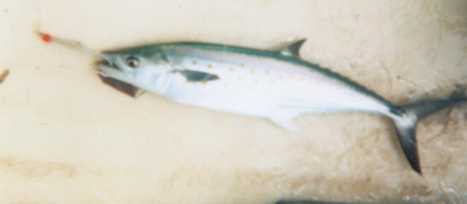
Spanish mackerel are beautifully colored pelagic fish. Their slender bodies are blue and silver, marked with yellowish oval shaped spots. They are known for their razor sharp teeth and keen eyesight. Average size Spanish mackerel are around 2-3 pounds; fish over 5 pounds are considered large in the Mid Atlantic states.
Spanish mackerel are fast growing, and may live to be 8 years old. Spanish mackerel form large, fast-moving schools, typically found in water temperatures above 68° F. Feeding fish sometimes cover acres of water.
During some seasons, their presence does not extend much beyond Virginia. In other years, they are common as far north as New Jersey. Spanish mackerel show up in summer, with their arrival varying from year to year.
Spanish often appear outside inlets, along tide rips and around wrecks or reefs. They also orient to shoals and other bottom structure out as far as 20 fathoms.
Anglers may see fish jumping out of the water anywhere from the surf to several miles out, most often during the first hour of daylight. Jumping fish may be ready to bite or have lockjaw. Good fishing can also occur when no fish are present on the surface.
Spanish mackerel are a bit finicky in regards to the tackle and techniques used. Anglers usually troll #00, #0 or #1 clark spoons for these fish. Light tackle is preferred, such as bay rods with #15 to #30 line.
A small ball bearing snap swivel on the line is essential for trolling. After the swivel, attach either a #1 drone planer or a small inline sinker from 2 to 8 oz. Attached to the sinker or planer is a 25 to 30 foot leader of #30 line with a small ball bearing swivel at it’s mid-point. The spoon is tied on the leader with a suitable knot.
Some anglers use a planer rig as one flat line and a trolling drail (weight) on the other flat line. Additional spoons or other lures can be trolled on outriggers. Rigger lines trail out 100 feet or more and the flat lines from 20 to 40 feet from the sinker to the stern or about 50 feet from the planer to the stern.
Boat speed is critical for catching Spanish mackerel. The fish often prefer fast lure speeds; as high as 7 knots. Fishing for Spanish mackerel is usually much more productive early in the day.
Early is defined as the soonest possible time after dawn. A crew that is willing to get an early start can have an excellent catch in a short time and sometimes every line will be hit as soon as it hits the water. Later in the day the fish get very shy and hard to catch.
They also travel up the Chesapeake Bay, occasionally far as Baltimore. In the bay, anglers use the same lures as techniques that are used in coastal fishing.
Spanish mackerel are also caught from fishing piers, bridges, and other vantage points, especially in North Carolina and Virginia. They are caught with small, shiny plugs or jigs. Most southern fishing piers offer a selection of lures for catching mackerel.
Spanish mackerel fishing may continue into the fall or until a hurricane or big storm triggers them to move south.